
Writeup CTF Vault (Cryptography)
Link Website: https://ctfvault.my.id/challenges


This write-up does not go into full detail on every concept. It mainly documents the steps I took to solve the challenge, with quite some help from AI-chan.
In upcoming posts, I’ll cover cryptography topics one by one in more depth.
Baby AES

I was given three files: baby_aes.py, baby_aes_output.txt, and strongpasswords.txt
key = random.choice(strongpasswords)
aes = AES.new(key, AES.MODE_ECB)
ciphertext = aes.encrypt(flag).hex()
baby_aes.py shows the whole flow: it picks a random line from strongpasswords.txt as the AES key, uses AES-ECB (no IV), reads flag.txt, encrypts it, and writes the hex ciphertext to baby_aes_output.txt
- AES keys can only be 16, 24, or 32 bytes long.
- Only those lines in strongpasswords.txt are valid keys.
- ECB mode doesn’t need IV/nonce, only the key.
- The flag length is already a multiple of 16 bytes (so no padding issue).
So the solve is straightforward: brute-force all candidates from strongpasswords.txt whose length is 16, 24, or 32; for each, try AES-ECB decryption of the ciphertext and check whether the plaintext looks like a flag (contains { and })
from Crypto.Cipher import AES

ciphertext = bytes.fromhex(open("baby_aes_output.txt").read().strip())

with open("strongpasswords.txt", "rb") as f:
    keys = f.read().splitlines()

def is_valid_key(k: bytes) -> bool:
    return len(k) in (16, 24, 32)

for i, k in enumerate(keys, 1):
    if not is_valid_key(k):
        continue
    try:
        c = AES.new(k, AES.MODE_ECB)
        pt = c.decrypt(ciphertext)
        if b"{" in pt and b"}" in pt:
            print("key =", k.decode(errors="ignore"))
            print("plaintext =", pt.decode("utf-8", errors="ignore"))
            break
    except Exception:
        continue
key = _JYympjH1b<T4&1b
key = _x\>&9AP%V}^aG*@
key = IW<t+#P!*~nLyW]:
key = 812aiJP;Vt)ajI0d
key = "viD2o"oLlwXT`%]
...
...
key = _:,?vD6CZ[>rmG%n
key = k84fE^+-O$z`vZ39
key = BOsgrngbh:vq*T\K
key = {1`mv",`]zpzmy5}
key = /mQE}}FEU=651W/k
key = u^J:E'j`nmjHy.`^
plaintext = PETIR{saya_sudah_install_pycryptodome_dan_bisa_AES_yeyeyeyeyeye}
Flag: PETIR{saya_sudah_install_pycryptodome_dan_bisa_AES_yeyeyeyeyeye}
Baby ECC
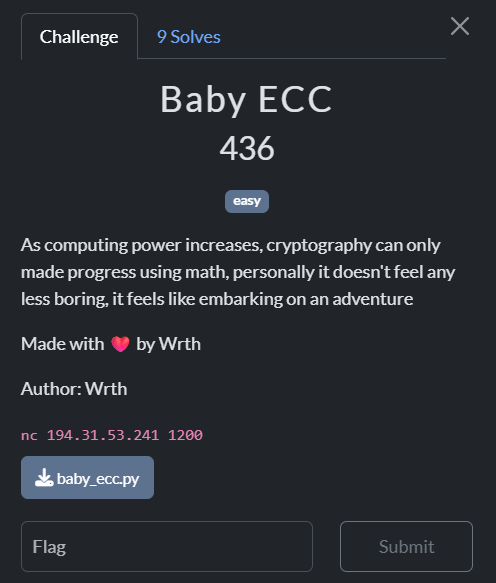
baby_ecc.py, a service that generates a random elliptic curve over a 512-bit prime field.
It then picks a random point G and asks: what is the y coordinate if x = G[0]
If you answer correctly, it prints the flag. Otherwise it reveals the correct y.
p = random_prime(2**512)
a = randrange(1, p)
b = randrange(1, p)
E = EllipticCurve(GF(p), [a, b])

while True:
    G = E.random_point()
    print(f"what is the y coordinate if x = {G[0]}")
The important detail is: every (x, y) must satisfy the curve equation:
y² ≡ x³ + a·x + b (mod p)
So if I can recover the curve parameters (p, a, b), I can compute the missing y for any challenge x
To recover the modulus p, I repeatedly give a wrong answer (1) so the server reveals the true y. With several (x, y) samples, I compute values whose gcd collapses to p
Then, using two samples, I solve for the curve coefficients a and b
After that, whenever the server asks for y given x, I just plug it into the curve equation, compute rhs = x³ + a·x + b mod p, and find the square root using Tonelli–Shanks.
There are two candidates (y and p − y); I try one, and if it’s wrong, the server reveals the other on the next round.
from pwn import *
from math import gcd

HOST = "194.31.53.241"
PORT = 1200

context.log_level = "debug"

def recv_line_containing(io, needle: bytes, timeout=5):
    while True:
        line = io.recvline(timeout=timeout)
        if not line:
            raise EOFError(f"remote closed while waiting for {needle!r}")
        if needle in line:
            return line

def egcd(a, b):
    if b == 0:
        return (a, 1, 0)
    g, x, y = egcd(b, a % b)
    return (g, y, x - (a // b) * y)

def invmod(a, m):
    a %= m
    g, x, _ = egcd(a, m)
    if g != 1:
        raise ValueError("no inverse")
    return x % m

def legendre(a, p):
    return pow(a % p, (p - 1) // 2, p)

def tonelli_shanks(n, p):
    n %= p
    if n == 0:
        return 0
    if p == 2:
        return n
    if legendre(n, p) == p - 1:
        raise ValueError("n is non-residue")
    q = p - 1
    s = 0
    while q % 2 == 0:
        q //= 2
        s += 1
    if s == 1:
        return pow(n, (p + 1) // 4, p)
    z = 2
    while legendre(z, p) != p - 1:
        z += 1
    c = pow(z, q, p)
    x = pow(n, (q + 1) // 2, p)
    t = pow(n, q, p)
    m = s
    while t != 1:
        i = 1
        t2i = pow(t, 2, p)
        while t2i != 1:
            t2i = pow(t2i, 2, p)
            i += 1
            if i == m:
                raise RuntimeError("tonelli: failed to converge")
        b = pow(c, 1 << (m - i - 1), p)
        x = (x * b) % p
        t = (t * b * b) % p
        c = (b * b) % p
        m = i
    return x

def recover_p(xs, ys):
    rs = [y*y - x*x*x for x, y in zip(xs, ys)]
    Ds = []
    n = len(xs)
    for i in range(n):
        for j in range(i+1, n):
            for k in range(j+1, n):
                xi, xj, xk = xs[i], xs[j], xs[k]
                ri, rj, rk = rs[i], rs[j], rs[k]
                D = (xi - xj)*(ri - rk) - (xi - xk)*(ri - rj)
                Ds.append(abs(int(D)))
    g = 0
    for d in Ds:
        g = gcd(g, d)
    return g

def recover_curve_params(p, x1, y1, x2, y2):
    r1 = (y1*y1 - x1*x1*x1) % p
    r2 = (y2*y2 - x2*x2*x2) % p
    a = ((r1 - r2) * invmod((x1 - x2) % p, p)) % p
    b = (r1 - a * x1) % p
    return a, b

def solve():
    io = remote(HOST, PORT)
    io.timeout = 5

    xs, ys = [], []
    need_samples = 8
    while len(xs) < need_samples:
        line = recv_line_containing(io, b"x = ")
        x = int(line.split(b"=", 1)[1].strip())
        io.sendline(b"1")
        reveal = recv_line_containing(io, b"correct answer is")
        y = int(reveal.split(b"is", 1)[1].strip())
        xs.append(x)
        ys.append(y)

    g = recover_p(xs, ys)
    p = g
    a, b = recover_curve_params(p, xs[0], ys[0], xs[1], ys[1])

    log.info("Recovered parameters")
    log.info(f"p (bits) = {p.bit_length()}")
    log.info(f"a = {a}")
    log.info(f"b = {b}")

    while True:
        line = recv_line_containing(io, b"x = ")
        x = int(line.split(b"=", 1)[1].strip())
        rhs = (pow(x, 3, p) + (a * x + b) % p) % p
        try:
            y0 = tonelli_shanks(rhs, p)
        except ValueError:
            io.sendline(b"1")
            _ = recv_line_containing(io, b"correct answer is")
            continue
        y_candidates = [y0, (p - y0) % p]
        io.sendline(str(y_candidates[0]).encode())
        resp = io.recvline(timeout=5) or b""
        if b"Correct!" in resp:
            flagline = io.recvline(timeout=5) or b""
            print(resp.decode(errors="ignore") + flagline.decode(errors="ignore"))
            break
        elif b"Wrong!" in resp:
            if b"correct answer is" not in resp:
                _ = recv_line_containing(io, b"correct answer is")
            continue

solve()
[*] Recovered parameters
[*] p (bits) = 512
[*] a = 6970490454002430135282598315301179024780320118758887412921354369381017719249005973937787789227093996352686406102068707501812810140047489138862805607929579
[*] b = 5434012670934479355551316849967148811177594272335927189267632780872564763573778972082584338918042879362487398251033359686034460057845361947417432259168251
Correct!
Here's the flag: PETIR{saya_sudah_mengerti_ECC_Yeyyye}
Flag: PETIR{saya_sudah_mengerti_ECC_Yeyyye}
Baby Classical
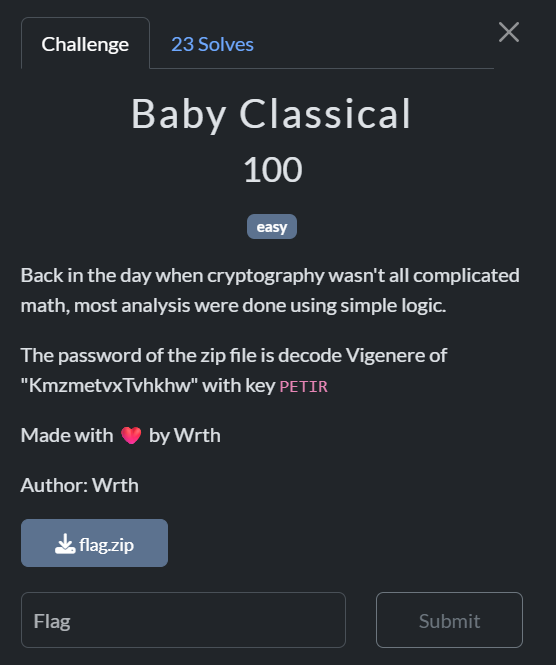
I was given a note that the first password is the Vigenère decryption of KmzmetvxTvhkhw with key PETIR (which decodes to VigenereLesgoo). Then there’s a second ciphertext and a hint that the key is 5 letters.
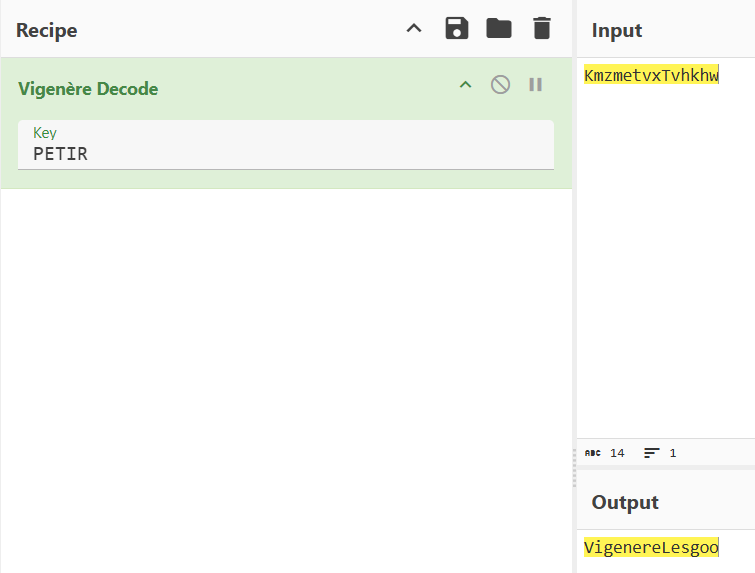
Using key PETIR in CyberChef (Vigenère Decode) gives the plaintext:
Congratulations, now can you help me to decrypt this?
It also uses Vigenere and the key is also 5 letter but I won't tell you the key this time :p
Remember, the flag format is PETIR{}

PWXVX{sscn_hike_prakwviad_gvvhwv_8nk7bx}

Note: you can solve this without bruteforcing, let's put that cryptographic skills to the test!
At first, I just guessed the key because the ciphertext started with ASENG{. It was my luck — I tried ASENG as the key and it worked.
But there’s also a systematic way to solve it. A quick way to find the 5‑letter key without bruteforce is to use the known flag prefix PETIR{.
Take the first 5 ciphertext letters PWXVX and align with known plaintext PETIR to recover the key by key[i] = (cipher[i] − plain[i]) mod 26 → this yields the key ASENG.
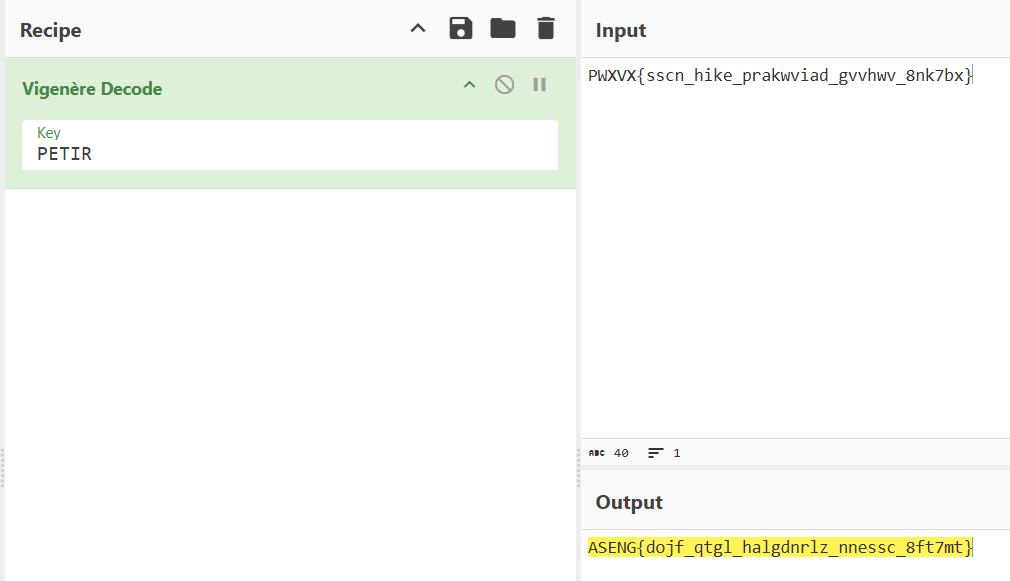
Using key ASENG in CyberChef (Vigenère Decode) gives the plaintext: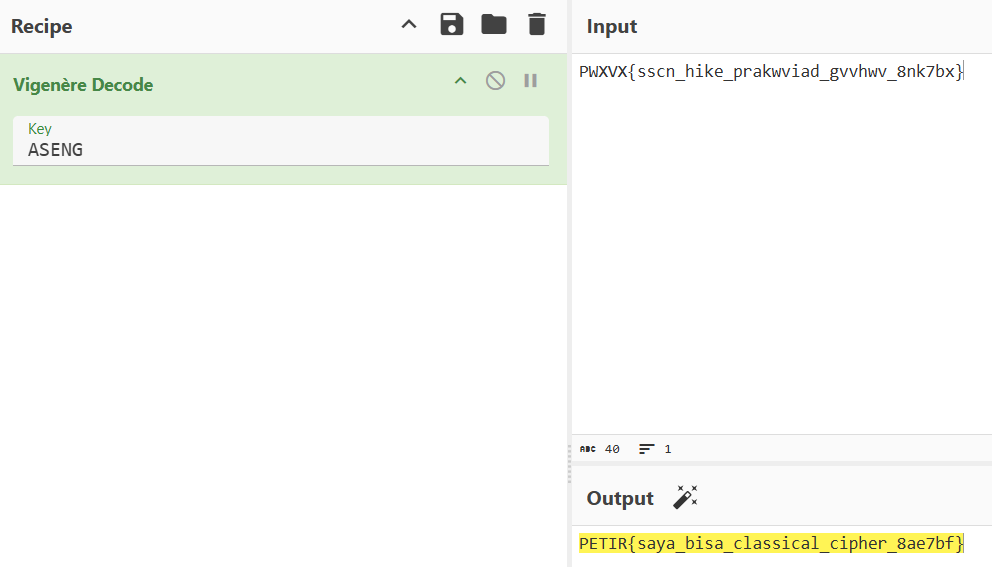
Flag: PETIR{saya_bisa_classical_cipher_8ae7bf}
Baby RSA
I was given baby_rsa.py and baby_rsa_output.txt. The script prints n, e, c and an extra value p - q.
# baby_rsa.py (core)
p = getPrime(1024)
q = getPrime(1024)
n = p * q
e = 65537
c = pow(m, e, n)
print(f"BONUS: p - q = {p - q}")
With n = p·q and k = p − q, we can recover the primes by solving a quadratic. Note that
(p − q)^2 + 4pq = (p + q)^2 ⇒ k^2 + 4n = (p + q)^2
Let s = sqrt(k^2 + 4n) = p + q. Then
p = (k + s) / 2
q = (s − k) / 2  (or q = p − k)
After factoring, compute φ = (p−1)(q−1), d = e^{-1} mod φ, and decrypt m = c^d mod n.
from Crypto.Util.number import bytes_to_long, long_to_bytes, inverse
import math

n = 14923873875109453127530673629552398972113857236927092965349378373739961796973217854411238048020657762893628870965487194767200476309931907607945075544279086782037257684303674574550284796779125454392656397651201679548115630973563249188636298533931515650571979075943709916119469204758259790227752851684077848622139115294011200988154875710930562745414422186967216785732157716088124213507225796166041599019951558479572071316728818921759653083122443549898010713320137090418897626169132769551228143237034394049027488653632942097757185094091514395521313419379878558449573567525441330154259240303681496948369555127420592946511
e = 65537
c = 9984341133350650078651603294087617832907031483531600845691188046561487793666207579786522068155426311703637153456725407498837797892324758928973687141590925466823278560885505757942047908833084279891896264160969027891341554101862313924890576880194348254456936173852798724640463810941788644048286779529455119916995669127583805564136112597168025834967759270749756533264965485516185825147694396041528237537028308968214851735948927725586875898195516597896048267563606609322835333057301978107717032346341504928400422866352524344842620334201766305680288380732714315923939846305412470146900439559259225819920093863070853458678
k = -19759470623835188613903910789493019028845084525246246197933467156297876127263769455636963970894797427707752462720600183791448324660124438010361609272101645200863244217862009495605992204797835421926797789664419752432768718116439739408991394968856238154386724848662811668109830614048640210302409168963181280834

delta = k**2 + 4*n
sqrt_delta = int(math.isqrt(delta))

q = (-k + sqrt_delta) // 2
p = q + k

phi = (p - 1) * (q - 1)

d = inverse(e, phi)
m = pow(c, d, n)

flag = long_to_bytes(m)

print(f"p: {p}")
print(f"q: {q}")
print(f"phi: {phi}")
print(f"d: {d}")
print(f"Flag: {flag.decode('utf-8')}")
p: 112682424610886493700490302450129010966902457975022273954114165585603727082105939159642508549043207301589616792251326534992866331162712984858501944156343118648229464673347830670637009917217182754184570444269629431399984395655344232049516722918165797196634998621951529199849965906921405223902458428617884912563
q: 132441895234721682314394213239622029995747542500268520152047632741901603209369708615279472519938004729297369254971926718784314655822837422868863553428444763849092708891209840166243002122015018176111368233934049183832753113771783971458508117887022035351021723470614340867959796520970045434204867597581066193397
phi: 14923873875109453127530673629552398972113857236927092965349378373739961796973217854411238048020657762893628870965487194767200476309931907607945075544279086782037257684303674574550284796779125454392656397651201679548115630973563249188636298533931515650571979075943709916119469204758259790227752851684077848621893990974165592812139991195240811704451772186491925991625995917760618883215750148391119617950970346448685085269505565667982472096136893142170645215735349207921575452604575098714348131197802193118731549975429263482524447584664386192013288578574690725901916845432875460086449477875790046290262229101221641840552
d: 3147045744449893071432532913627632540314837527111897474420989809193070662895309073469388434375169603173626363683766926036936548554301523767365014328119031681763811300442143867132840012382127863339892143606506358413643560432345760467933436772188741417686265023262310924222516508380901632679975348433311806581848039355829050653276388579248791030341997522274721412397138465041911484597123259391874408655910557210748552396731112463669648662108608316291534810587340373429912457924458364957692466441149675891494423312944327957161418215970548196799115738527888457389939893554516362640870527858208621690517173599323787940193
Flag: PETIR{saya_bisa_RSA_dan_aljabar_yeyeyyyy}
Flag: PETIR{saya_bisa_RSA_dan_aljabar_yeyeyyyy}
Baby Coppersmith
At first I thought this was about Coppersmith (since the name suggests it). But when I noticed the extra BONUS ciphertext, it clicked that the problem was actually easier, it was just a case of the Franklin–Reiter Related Message Attack.
I was given:
c = m^3 mod nBONUS = (2m+1)^3 mod n
Both are encryptions of linearly related messages under the same modulus and exponent. That’s exactly the Franklin–Reiter scenario:
- Message 1:
m - Message 2:
2m+1 - Same public key
(n, e)withe = 3
I considered the two polynomials modulo n:
f(x) = x^3 - cg(x) = (2x+1)^3 - BONUS
Since both vanish at x = m, they share the root. Instead of computing a full GCD (difficult in ℤ/nℤ), I eliminated the cubic terms by taking a linear combination:
(16x + 16)·f(x) + (-2x + 1)·g(x) = A·x + B
Where:
A = -16c + 2·BONUS + 4B = -16c + 1 - BONUS
Because m is a common root:
A·m + B ≡ 0 (mod n)
So:
m ≡ (16c - 1 + BONUS) * (2·BONUS + 4 - 16c)^(-1) mod n
This gives me m directly, unless the denominator shares a factor with n (in which case, I could factor n and decrypt normally).
from sage.all import *
import sys, re

def parse_io():
    txt = open('baby_coppersmith_output.txt','r').read()
    vals = {}
    for line in txt.splitlines():
        m = re.match(r'\s*(n|e|c|BONUS)\s*=\s*([0-9]+)', line)
        if m:
            vals[m.group(1)] = Integer(m.group(2))
    return vals["n"], vals["e"], vals["c"], vals["BONUS"]

def to_bytes(i):
    i = Integer(i)
    ln = (i.nbits() + 7)//8
    return i.to_bytes(ln, 'big')

def solve():
    n, e, c, bonus = parse_io()
    Zn = Integers(n)
    den = Zn(2*bonus + 4 - 16*c)
    num = Zn(16*c - 1 + bonus)

    g = gcd(Integer(den), n)
    if 1 < g < n:
        p = g; q = n // g
        phi = (p-1)*(q-1)
        d = inverse_mod(e, phi)
        m = power_mod(c, d, n)
    else:
        m = Integer((num * den.inverse()).lift())

    pt = to_bytes(m)
    try:
        print(pt.decode())
    except:
        sys.stdout.buffer.write(pt + b"\n")

solve()
$ sage solve.sage
PETIR{saya_sudah_install_sagemath_dan_juga_sudah_mengerti_basic_coppersmith_theorem_yeyeeyeyyyeyeyeyeyeyeyeyyeyeyeyeyeyyeyeyeyey}
Flag: PETIR{saya_sudah_install_sagemath_dan_juga_sudah_mengerti_basic_coppersmith _theorem_yeyeeyeyyyeyeyeyeyeyeyeyyeyeyeyeyeyyeyeyeyey}
Baby LLL

When I saw the challenge, the description said it was about LLL.
LLL stands for Lenstra–Lenstra–Lovász lattice basis reduction. In CTFs, I usually use it when:
- I need to recover small unknown integers from a large linear relation.
- I want to find short vectors that reveal some hidden structure.
Here the problem gave me:
- Ten large primes
b[i](≈256‑bit). - Ten small primes
a[i](16‑bit) hidden. - A single equation:
S = Σ a[i]*b[i]. - AES key = md5(∏ a[i]).
This is the classic small‑coefficient linear combination case. LLL can recover the a[i].
I built a lattice of dimension 11:
- For each
ifrom 0 to 9, I created a row with a large scaling factorMon the diagonal andb[i]in the last column. - I added one more row with all zeros except the last entry
S.
So the lattice looks like:
[M      0   ...   0   b1]
[0      M   ...   0   b2]
[...                ...]
[0      0   ...   M   b10]
[0      0   ...   0    S ]
If I take the integer combination Σ a[i]*(row_i) − 1*(last_row), I get:
(M*a1, M*a2, …, M*a10, Σ a[i]b[i] − S ) = (M*a1, …, M*a10, 0)
This is a very short vector compared to random ones, so LLL should find it.
from sage.all import *
import ast, re, sys
from hashlib import md5
from Crypto.Cipher import AES
from Crypto.Util.Padding import unpad

def parse():
    txt = open('baby_LLL_output.txt','r').read()
    b = ast.literal_eval(re.search(r"b\\s*=\\s*(\\[.*\\])", txt).group(1))
    S = Integer(re.search(r"S\\s*=\\s*([0-9]+)", txt).group(1))
    ct_hex = re.search(r"ct\\s*=\\s*([0-9a-fA-F]+)", txt).group(1)
    ct = bytes.fromhex(ct_hex)
    return [Integer(x) for x in b], S, ct

def recover_a(b, S, M=2**24):
    n = len(b)
    rows = []
    for i in range(n):
        row = [0]*n + [int(b[i])]
        row[i] = int(M)
        rows.append(row)
    rows.append([0]*n + [int(S)])
    L = Matrix(ZZ, rows)
    B = L.LLL()

    cands = []
    for r in B.rows():
        if r[-1] == 0:
            v = r[:n]
            if all(v[i] % int(M) == 0 for i in range(n)):
                a = vector([v[i]//int(M) for i in range(n)])
                if sum(1 for x in a if x < 0) > n//2:
                    a = -a
                cands.append(a)

    for a in cands:
        if sum(int(a[i])*int(b[i]) for i in range(n)) == int(S):
            return [int(abs(x)) for x in a]

    raise ValueError("No valid vector found; try larger M")

def solve():
    b, S, ct = parse()
    a = recover_a(b, S, M=2**24)
    x = Integer(1)
    for ai in a:
        x *= ai
    key = md5(int(x).to_bytes((x.nbits()+7)//8, 'big')).digest()
    pt = unpad(AES.new(key, AES.MODE_ECB).decrypt(ct), 16)

    print("a =", a)
    print("flag =", pt.decode(errors='ignore'))

solve()
$ sage solve.sage
a = [64717, 59791, 40763, 61553, 52433, 53269, 52181, 35521, 46261, 50503]
flag = PETIR{saya_sudah_mengerti_LLL_dan_surely_kali_ini_saya_sudah_install_sage_yey}
Flag: PETIR{saya_sudah_mengerti_LLL_dan_surely_kali_ini_saya_sudah_install_sage_yey}
babyPRNG
I was given babyPRNG.py. The program uses Python’s random.getrandbits(128) each round, then subtracts i² where i is the round counter.
The menu has two options:
- Show the “random” number (actually
random.getrandbits(128) - i²) - Guess the next one. If correct, the flag is revealed
print(f'Angka: {random.getrandbits(128) - pow(i,2)}')
This shows the key weakness: it’s just the Mersenne Twister PRNG. By feeding enough outputs, we can reconstruct the internal MT19937 state. Once the state is recovered, we can predict all future values perfectly. The - i² part is trivial to undo (just add i² back before feeding into the predictor).
from mt19937predictor import MT19937Predictor

predictor = MT19937Predictor()
true_val = num + (i * i)  # undo "- i^2"
predictor.setrandbits(true_val, 128)
Using MT19937Predictor, we collect 624×32 bits = 19968 bits of state (156 samples of 128 bits each). After training, we predict the next output with .getrandbits(128), then subtract (i²) to match the server’s format.
Finally, we select menu option 2 and send the predicted guess.
from pwn import *
from mt19937predictor import MT19937Predictor

HOST = "194.31.53.241"
PORT = 1201

context.log_level = "debug"

def recv_line_containing(io, needle: bytes, timeout=5):
    while True:
        line = io.recvline(timeout=timeout)
        if not line:
            raise EOFError(f"Remote closed while waiting for {needle!r}")
        if needle in line:
            return line

def solve():
    io = remote(HOST, PORT)
    io.timeout = 5

    predictor = MT19937Predictor()
    i = 0
    fed_bits = 0
    needed_bits = 19968  # 624 * 32 bits

    try:
        io.recv(timeout=0.2)
    except EOFError:
        pass

    while fed_bits < needed_bits:
        io.sendline(b"1")
        line = recv_line_containing(io, b"Angka:")
        num = int(line.split(b":", 1)[1].strip())
        true_val = num + (i * i)  # undo "- i^2"
        predictor.setrandbits(true_val, 128)
        i += 1
        fed_bits += 128

    log.info(f"Predictor trained with {i} samples ({fed_bits} bits)")

    pred_val = predictor.getrandbits(128)
    guess = pred_val - (i * i)
    log.info(f"Predicting next value for i={i}: {guess}")

    io.sendline(b"2")
    io.recvuntil(b"jawaban:")
    io.sendline(str(guess).encode())

    print(io.recvall(timeout=5).decode(errors="ignore"))

solve()
[*] Predictor trained with 156 samples (19968 bits)
[*] Predicting next value for i=156: 205073855668248932004801626701815961386
Nais! ini flagnya: b'PETIR{Random_kek_gini_bisa_dibreak_tau}'
Flag: PETIR{Random_kek_gini_bisa_dibreak_tau}
Rogue Transmission
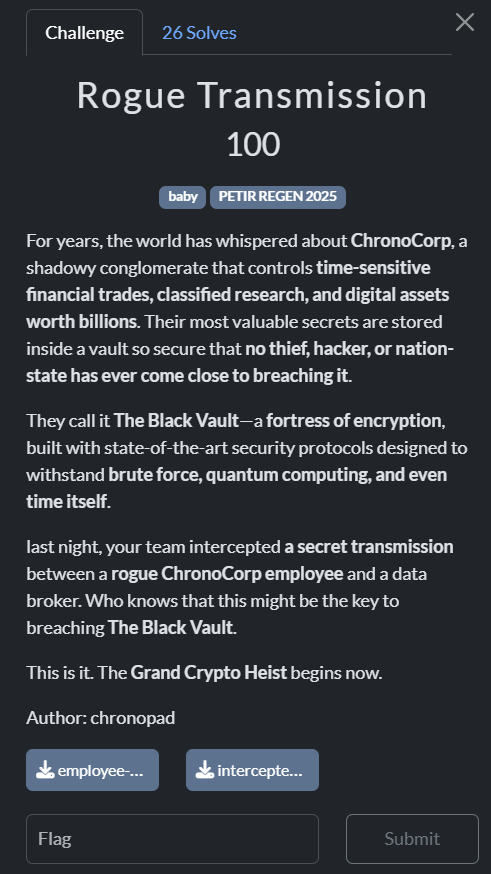
employee-profile-picture.jpg and intercepted-enc.txt

Intercepted Communication Log
From: Orion-X762 (Rogue Employee)
To: ZeroTrace47 (Dark Web Data Broker)
Timestamp: 03:17 AM UTC

Message Start
SHltdWUtWDc2MjoKViBndnLigJliIHp0b2wgcWF0aCBnbHRpLiBLemtodXNJZnJjIGx6IGxxdmJnbiB3dWRlZ2twcm8gdGJ64oCUenNzdnR1bHVrIG1ueGcgYWxrenIgcmFsZ2NsYm9sdyBnaWVh4oCZdyB6eXhoaGxsaCB6ZiBrYXJkIGVqZ25tLgoKR2l4ZlRlZGppNDc6Ck9nIGhnLiBJeXogcG9oIG51c2UgbGF4IHl5cnZz4oCUdnFtcyB0YWR4IGFsb2ogaWZx4oCZYSBqend4LgoKSHltdWUtWDc2MjoKViBndnLigJliIGZ4eGsgcXVlZWwuIEwgdWltdiB4cWF2Z3R0dnJ1LiBLbWwgZnggdnl6IGZmIGdrcHcgdXdsbCwgaHJqIFrigJlseSBqcHptIHFobiB6c3N2dHVsdWsgdmcgaGdsIGlyamUgdWR6LgoKRG1qaE15ZWl2NDc6CkRyc2xybGsgaGcgYWxrIG1heXhsLiBBcHNtIHR5aSBjdiB0bm9ybXZ5IHR1dnl6PwoKRnJ2cnUtQjc2MjoKSWYgeHFhaXhlYXkgeWh5dGwuIEh5bS1reHpkLiBBciB2am5hdmJocCB4dmNidWt3LiBReCBsaHRpdWVlIGpoeWkgYmfigKYgenRwciBndGNydnosIHhwd3IgcHZ5cnVu4oCZZyBtYndiIHl4bSBrZXpy4oCUdHVoZuKAmWggb3dtIGx2cWtraHZxbiBHcGpoZ3ZHdWlwIHBkdeKAmXggaXh5aHloIHpmIGxidmwuCgpEbWpoTXllaXY0NzoKU2J4dWhhIGRiZGwgZSBscmllYmFldHcuIFBhbHZr4oCZaiB5Ynh5IHR6Z2h5PwoKVnZvZm4tSzc2MjoKTCBuc2IgYWdtdiBlIGljYWZ2cGpxd3cgd2h4Z3NhZmggc2VhbCBnYm5sei4gS2hyIGhleG1qZ3RzIHpnbGxnIGx6IHZtc2UuIFZvdnVlb1ByeXQga3NlZXogbXogR3JibWxnYiBHdWxwaG9ybi4KCk1oeXNCanR2bDQ3OgpQdXRhZ2x2cj8KCldqYmh1LUI3NjI6Ck8gdGFh4oCZdyB6ZWcgYW0gaGJ4eHpndXcuIEFsbXEgZmh1bXpmciByeWx2Z2xhYnVrLiBIbHQgVuKAmXlsIHBteG0gbW9pIGlmb2VncHJpbHhsIG9tanVlYeKAlGh1Z3pxaW1saCwga2VjYmdsaCwgam1rYmxoIG9lIHB5ZHByIGFhemFhLiBDdWzigJlseSBxbGlsIGxoIHVsIHdzcnJnIHd2IGpxZncgYmEuCgpEa2lvR3VoZ200NzoKWGJnbC4gRmFrIHlieCBpaWJseGsgb3N2diB5Ynh5IG12eGhrdGV6em9hIGx6IHd3ZGJ3LiBJaWlydWZoIHBqIGJ6YmwgcHcgZyBrcm5zLCBmc2PigJlqeCBndnggenllIGJxc2Mgd2Z4IHBvc+KAmXJjIG5yaGsgZXYgd3FteWVpa2licS4KClZ2cWdnLVE3NjI6CkF2YWp0IHpoLiBQaiBnZ24gemx4IG9lLCBDdXV2cndVaGt3IGF1ZeKAmXQgcnlsciBzZmhwIGFsa3DigJl2ciBlbGl2IGpodWlpauKAlGxuZ2xzIG1i4oCZayBtaHYgcGdrZS4gTHJiJ3B0IG90Z2EgeG56czogQ0hBTVp7M254S2ZYbjFlR19mVzR5eEFfbzFtQV9jMWtrZWVlM30

Message End
When I reverse-searched the image on Google, it identified the person as Blaise de Vigenère.
That was the first big hint, this is likely a Vigenère Cipher challenge.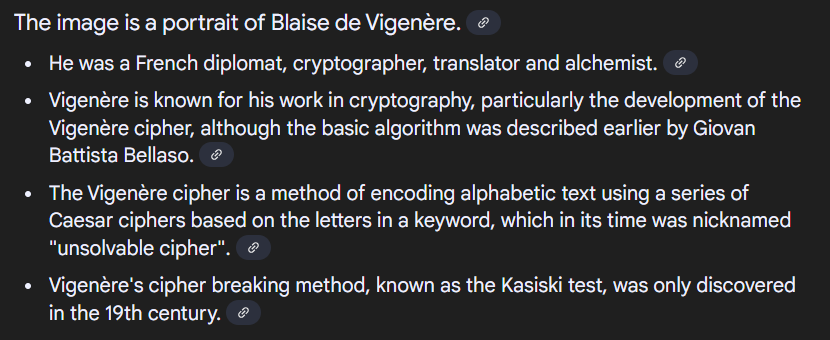
Also, the intercepted message looked Base64 encoded. So the plan was:
- Decode from Base64
- Decrypt using the Vigenère cipher with the correct key
After decoding the Base64, I got the following:
Hymue-X762:
V gvr’b ztol qath glti. KzkhusIfrc lz lqvbgn wudegkpro tbz—zssvtuluk mnxg alkzr ralgclbolw giea’w zyxhhllh zf kard ejgnm.

GixfTedji47:
Og hg. Iyz poh nuse lax yyrvs—vqms tadx aloj ifq’a jzwx.

Hymue-X762:
V gvr’b fxxk queel. L uimv xqavgttvru. Kml fx vyz ff gkpw uwll, hrj Z’ly jpzm qhn zssvtuluk vg hgl irje udz.

DmjhMyeiv47:
Drslrlk hg alk mayxl. Apsm tyi cv tnormvy tuvyz?

Frvru-B762:
If xqaixeay yhytl. Hym-kxzd. Ar vjnavbhp xvcbukw. Qx lhtiuee jhyi bg… ztpr gtcrvz, xpwr pvyrun’g mbwb yxm kezr—tuhf’h owm lvqkkhvqn GpjhgvGuip pdu’x ixyhyh zf lbvl.

DmjhMyeiv47:
Sbxuha dbdl e lriebaetw. Palvk’j ybxy tzghy?

Vvofn-K762:
L nsb agmv e icafvpjqww whxgsafh seal gbnlz. Khr hexmjgts zgllg lz vmse. VovueoPryt kseez mz Grbmlgb Gulphorn.

MhysBjtvl47:
Putaglvr?

Wjbhu-B762:
O taa’w zeg am hbxxzguw. Almq fhumzfr rylvglabuk. Hlt V’yl pmxm moi ifoegprilxl omjuea—hugzqimlh, kecbglh, jmkblh oe pydpr aazaa. Cul’ly qlil lh ul wsrrg wv jqfw ba.

DkioGuhgm47:
Xbgl. Fak ybx iiblxk osvv ybxy mvxhktezzoa lz wwdbw. Iiirufh pj bzbl pw g krns, fsc’jx gvx zye bqsc wfx pos’rc nrhk ev wqmyeikibq.

Vvqgg-Q762:
Avajt zh. Pj ggn zlx oe, CuuvrwUhkw aue’t rylr sfhp alkp’vr eliv jhuiij—lngls mb’k mhv pgke. Lrb'pt otga xnzs: CHAMZ{3nxKfXn1eG_fW4yxA_o1mA_c1kkeee3}
The string CHAMZ{3nxKfXn1eG_fW4yxA_o1mA_c1kkeee3} looked like a flag, but it was still encrypted. So I needed the Vigenère key.
I guessed the key might come from the challenge description.
First, I tried “thegrandcryptoheist”, it didn’t make sense.

Eventually, “thegrandheist” fully decrypted the message:
Orion-X762:
I don’t have much time. ChronoCorp is hiding something big—something even their executives aren’t supposed to know about.

ZeroTrace47:
Go on. But you know the rules—info like this isn’t free.

Orion-X762:
I don’t need money. I need extraction. Get me out of this mess, and I’ll give you something no one else has.

ZeroTrace47:
Depends on the value. What are we talking about?

Orion-X762:
An external vault. Off-grid. No official records. If someone were to… gain access, they wouldn’t just get data—they’d get something ChronoCorp can’t afford to lose.

ZeroTrace47:
Sounds like a fairytale. Where’s your proof?

Orion-X762:
I got into a classified database last night. The external vault is real. ChronoCorp calls it Project Obsidian.

ZeroTrace47:
Location?

Orion-X762:
I can’t say it outright. They monitor everything. But I’ve left the coordinates hidden—encrypted, encoded, buried in plain sight. You’ll need to be smart to find it.

ZeroTrace47:
Fine. But you better hope your information is solid. Because if this is a trap, you’re not the only one who’ll need an extraction.

Orion-X762:
Trust me. If you get in, ChronoCorp won’t even know they’ve been robbed—until it’s too late. You'll want this: PETIR{3veRyTh1nG_sT4rtS_w1tH_v1gener3}
Flag: PETIR{3veRyTh1nG_sT4rtS_w1tH_v1gener3}
101_-_Cryptography
The challenge provided a single file to download, chall.txt:
c = 231722077914684998818993776518942509384465803531548983146869754932667754136315007943497593396644630089073196170276638447665765624960333289097324447779290700092664403080584161276778064977902852018557301618273474139777712464709585187730351308079009718870031364399745764326436147001877583703027251271265576350621173
e = 65537
n = 257208938346934642693512128888810986151634836498153528507638790770764504946719195736987613302526116425873247750032929224521429342437621496424825810959518932424007107126934957421561529561264636001476988808843995824395131838577901446930016348590793828420808295335603083382120208905347497068915850813369038886980997
This is RSA encryption.
cis the encrypted message (ciphertext).eis the public key exponent (usually 65537).nis the modulus, a big number made by multiplying two secret primespandq.
RSA is secure because it’s really hard to find p and q from n when the numbers are large.
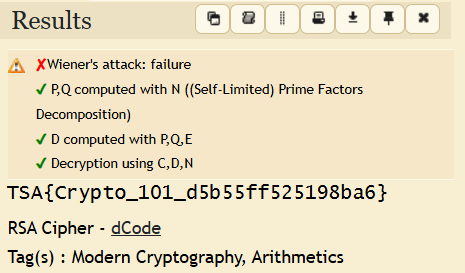
To solve this, I used the online tool dCode.fr and entered the values of c, e, and n to decrypt the message.
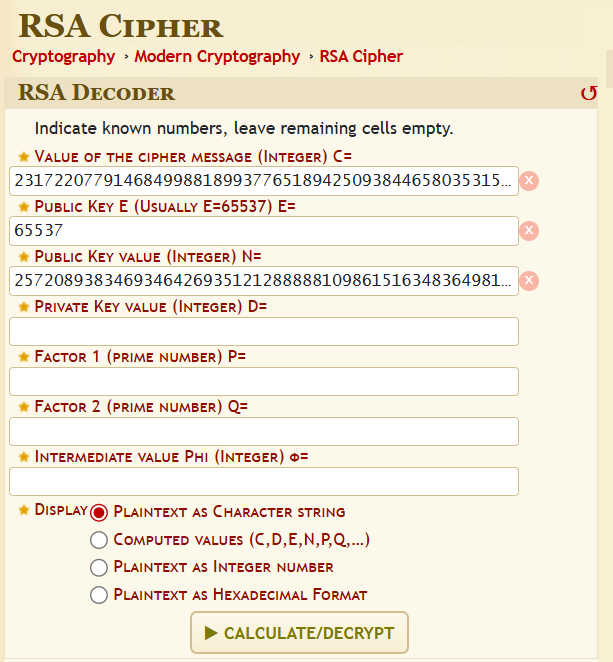
The tool automatically factored n, calculated the corresponding private key d, and then decrypted the ciphertext to reveal the flag.
External Cache
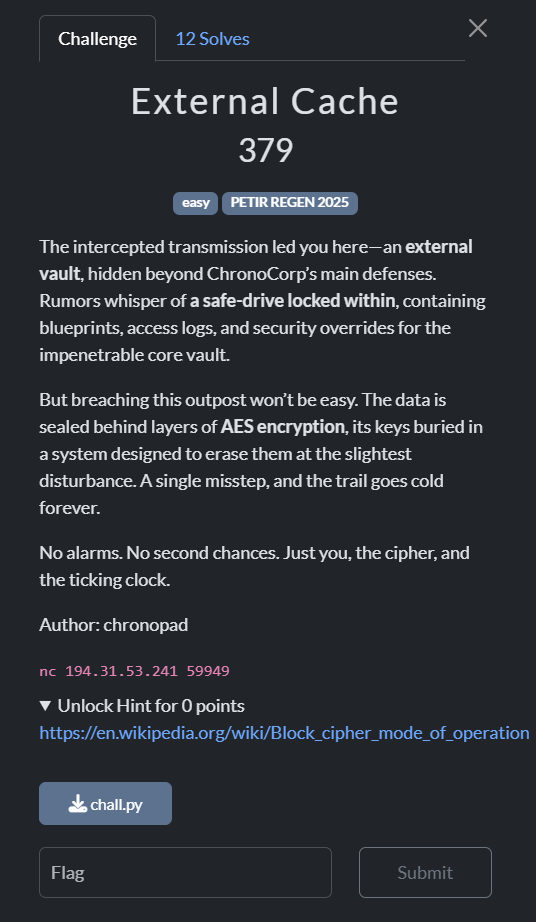
I was given chall.py. The program sets up an AES-based service with three options
1. Get encrypted PASSPHRASE.
2. Decrypt ANYTHING.
3. Enter PASSPHRASE.
The goal is to recover the random 32-byte PASSPHRASE and enter it to reveal the flag.
- The “encrypt” function mistakenly calls
cipher.decryptunder AES-CBC. - The “decrypt” function uses AES-CFB decryption.
This mismatch gives us an oracle that lets us reconstruct the plaintext from ciphertext blocks using CFB mode’s structure.
def cfb_oracle_E(io, block16):
    payload = block16 + b"\x00" * 16
    io.sendline(hexlify(payload))
    out = io.recvline().strip()
    return unhexlify(out.split(b":", 1)[1].strip())
The exploit works by sending crafted inputs to the decryption oracle. For each ciphertext block Oᵢ, we compute an intermediate Yᵢ, query the oracle, and recover the corresponding plaintext block Pᵢ. Repeating this for all four blocks yields the full 32-byte PASSPHRASE.
from pwn import *
from binascii import unhexlify, hexlify

HOST = "194.31.53.241"
PORT = 59949

def xor_bytes(a, b):
    return bytes(x ^ y for x, y in zip(a, b))

def recv_menu(io):
    io.recvuntil(b"> ")

def get_encrypted_passphrase(io):
    recv_menu(io)
    io.sendline(b"1")
    line = io.recvline().strip()
    hexdata = line.split(b":", 1)[1].strip()
    data = unhexlify(hexdata)
    iv, rest = data[:16], data[16:]
    assert len(rest) == 64
    return iv, [rest[i:i+16] for i in range(0, len(rest), 16)]

def cfb_oracle_E(io, block16):
    recv_menu(io)
    io.sendline(b"2")
    io.recvuntil(b"Enter data: ")
    payload = block16 + b"\x00" * 16
    io.sendline(hexlify(payload))
    out = io.recvline().strip()
    hexout = out.split(b":", 1)[1].strip()
    res = unhexlify(hexout)
    assert len(res) == 16
    return res

def submit_passphrase(io, phex_str):
    recv_menu(io)
    io.sendline(b"3")
    io.recvuntil(b"Enter PASSPHRASE: ")
    io.sendline(phex_str.encode())
    resp = io.recvuntil(b"\n", timeout=2) or b""
    more = io.recv(timeout=1) or b""
    return (resp + more).decode(errors="ignore")

def solve():
    io = remote(HOST, PORT)

    iv, blocks = get_encrypted_passphrase(io)
    O1, O2, O3, O4 = blocks

    Y1 = xor_bytes(O1, iv)
    P1 = cfb_oracle_E(io, Y1)

    Y2 = xor_bytes(O2, P1)
    P2 = cfb_oracle_E(io, Y2)

    Y3 = xor_bytes(O3, P2)
    P3 = cfb_oracle_E(io, Y3)

    Y4 = xor_bytes(O4, P3)
    P4 = cfb_oracle_E(io, Y4)

    passphrase_bytes = P1 + P2 + P3 + P4
    try:
        passphrase_str = passphrase_bytes.decode("ascii")
    except UnicodeDecodeError:
        log.failure("Recovered bytes not ASCII; something went wrong.")
        io.close()
        return

    log.success(f"PASSPHRASE = {passphrase_str}")
    result = submit_passphrase(io, passphrase_str)
    print(result)

    io.close()

solve()
Output:
[+] Opening connection to 194.31.53.241 on port 59949: Done
[+] PASSPHRASE = 75d6dfcac1c12d064a6b83cc2cc88211b5fc811dfffac1ffc46c1436cedfd827
PASSPHRASE Correct!
You opened the vault and found an encrypted USB drive along with a secret phrase.

Secret Phrase: PETIR{th3r3_ar3_4_l0t_0f_a3s_m0d3s_e8fdb51e088}
P.S. The secret phrase is not related to the drive...
You succesfully open the vault...

[*] Closed connection to 194.31.53.241 port 59949
Flag: PETIR{th3r3_ar3_4_l0t_0f_a3s_m0d3s_e8fdb51e088}
RSA Odyssey
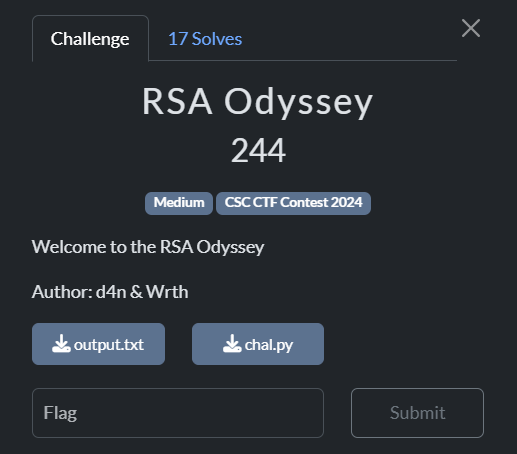
I was given chal.py and output.txt. The program generates two 256-bit primes p, q and prints out n, e, c, n2, c2.
The twist is that n2 is created by multiplying 50 random picks from [p, q, p, q, p, 1]. Because p appears more often than q, this bias means that gcd(n, n2) (or variants of it) can reveal one of the primes.
from math import gcd
from Crypto.Util.number import inverse, long_to_bytes

e = 65537
n = 6559507514380552440843660542046459988292887865569577579829541416371049918320110715995867527663846919151480304401473261316651848691527586719598599193398517
c = 5567563859914808786736717644316284940835416379210022360271578932389576763409549731214169817460730282371184899803313505854680299064878629755132704625006819
n2 = 14752068863792092244029937504376450919107150178502354591464376207889029780215873771100433324721236504424501007820347668053108016994474337954711779752388322240793022351707057544360595002936656576570213024021859060716202601050426837951399062354450648959625614381511185956840832892727688567425381562196255003435214749745667584884822612164774803140550645934722904271749801005411173497104355466846877026160180499874371028974534681545516865328129592351744907807775823917831832769524221528154207005559945329166112449369384539259146045155004393519463535413387983403161322502456508032971847333468773487524675408512126708065193038498605055733768684350616497083743238939926482963730031715972339372945583562141002178157457866568478735513696637710009083768841305648138115155184206409945984975698544311974775439202153771539624297605480123098890046193487541958435639367729341790478912344589564287736866359754740658508853782369456842888276172804842493107379660867685866871145414917380032083678321346970616178634986441547930075361003372875240170336233850691687040407962249553972113184660749523664842169200316505008677737041479500828351789965310371884226217090954520794612117482245267223771649192830551410837594598079847933297273583897508157607605405548062951890706002571387121785424602878361659648009876812992356744982573211817633783046962694045163283081794877132456470214811022747830982698933500909095135021937900309988815197581584495297935134669807226951671136762192271026921127156273968656375681894912834985622214133768958578671647568492598873561946174093357663201066401755367992558554049960630150793584120802665834670781022649348007423223987395219382616391371043971468950662309927763348465831165066932580206202352409514776905362775163216865146507482031641232873520090973037448420553422904957283453380874518055774434775113381474292441201534888614990317760111707909562716400843271784313502084641185962162168208034662687022855611074534067998536620551565385593114034114289363441136684692300994121866999515240657475114486098343994909163291965612272832459426201065312221154481220391409463463506548303844785294728633494232087379788215816579317182803113733676524079504770309375040818664540904698395880877642281435668755190228265094458713620001569238327

def recover_pq(n, n2):
    factor = gcd(n, n2)
    if 1 < factor < n:
        return factor, n // factor
    if n2 % n == 0:
        ratio = n2 // n
        factor = gcd(ratio, n)
        if 1 < factor < n:
            return factor, n // factor
    for i in range(1, 30):
        if n2 % (n**i) == 0:
            ratio = n2 // (n**i)
            factor = gcd(ratio, n)
            if 1 < factor < n:
                return factor, n // factor
    return None, None

p, q = recover_pq(n, n2)
print(f"Found p = {p}")
print(f"Found q = {q}")
print(f"Verification: p*q = {n}")

phi = (p - 1) * (q - 1)
d = inverse(e, phi)
m = pow(c, d, n)
flag = long_to_bytes(m).decode()
print(f"Flag: {flag}")
Found p = 74692952160045976822418265020999156316008118160638490254137673627571439844647
Found q = 87819631232748355909321913062464242966404013991738056145053602903416100974211
Verification: p*q = 6559507514380552440843660542046459988292887865569577579829541416371049918320110715995867527663846919151480304401473261316651848691527586719598599193398517
Flag: CSC{s0me_b4sic_r5a_chall_ig_1a9f4560}
Flag: CSC{s0me_b4sic_r5a_chall_ig_1a9f4560}
Rese Sangad Ah

I was given two files: Rese.py and outputrese.txt. The program splits the flag into 7‑byte chunks, then encrypts each block with RSA using modulus n = p*q.
The trick: the code reuses the same p across pairs of moduli, so consecutive n0, n1 share a common prime.
for i in range(len(data)):
    if(i % 2 == 0):
        p = getPrime(512)
    q = getPrime(512)
    n = p*q
    list_n.append(n)
    enc.append(pow(data[i], e, n))
That means every even/odd pair of n shares the same p. Using gcd(n0, n1) reveals it.
from Crypto.Util.number import bytes_to_long, long_to_bytes, inverse
from math import gcd

list_n = [100500953328948519741999166862671012320983782714791989491896077035456515343525571120532006194347418931112085669155690311852786996726250989509180843416969549604357354754889298351745924569855392998531182646041387359953969978284285031645459216155399282510986180348458975336489329470965908196247029222652999880659, 108635445426345226959977767245611569053609679766481461903295736847837286964629987401504824429149330642008344610767888554120929346085809712824590446699530837122619370966122629281030677179490865173592018525299346077704450081985722828045915825212518291972991286093034608737226054656394569212750053109783780533581, 80470050287131598978696541366388418423204876787995979864511531775829288613580464853289148162617709945955267132052563148273772407813220010985183269107477832618025167259382525706268220845271300961076480617306830016634129091418968060300432141859298440146707558914134156458986309562356397563483312942485341730057, 116531623353370302798016648575802736186818831002412828410474597473171596612051669958669130121470906061324193411072759530782050242069832802260209152973319898512252944481864999013400631268227631076445922584484820514061245137769226951348468060453404052705485978005388144393413918125156766080505233902884361253191, 85787708545148317270768843917226621841253082433952293189553255808322950373235612066091141467729426470972639089279792633663365291351874917778171214676465036704856061081353682725594205242878694877836924521879634194260047984830596619703644453161024759114837127789231723927533391991666242031608156097412323286001, 60279136619680191011829958916053428084507889939379606997929365762804038186406382955853177986215648755450230192574135482731903001635466742169895484922339005561253467064511621026992080075102349305907491603867557483512249531123954875645634296154998414557932548823701061959627274367310257645013240563676510324119, 64633094654555389367347212851848296001698849267290432050496703932769373764398829309825357382264856515407413706195854440694096829224329873252048416657208563848979125185630825709150328400141749770568865443025818099236001792593797389239228535910727096095989722290764709308631392595800145441796102598876585993803, 61943917162083682207808107308419728686611692977328455489255089896255140057675411929599370671516562827568851581949135524478954101187548666251252397037336547801544457833095844853792042713227957092565599679768632644550259438801440094132831384320534714789700960132683513967693781775516127086344673762160028953843]
enc = [14533793473539538168081662135033556989065080748506397799743954771115740119240657786804980131307036321989981772587107842171845753453322486470494738855686853561824124161743851678093101543652653845180472949648066812054763346646290487665826898319907582011001438217050163018342934121498995903651016321113985107052, 49882868711109404002746433078246646292446738091012557332484588080234014669350887245807846092094335103967239202170888278829164624855700957933288240621156896370264085344646969676508438077139198102177583983016263868036953351815830458958651131921598415635068542991905241731388835494438724522286748123450068157411, 79882301466846402980282165066426034710615139639232121097627995558240832561036059300417816119312634252320830890178673529867694569819499421421102017441609774784381951142265950853174939850506854487720323384504698450600723792192005876784503978986624213877058984408116244856430993839007195592328903617207069086274, 113096195412075887202909707362051725012864810884873723396295531146183552762794213463778052777921861444475560235125149400039793597784137660251049645498154009807915776735189510416493725213384370460118984902554179890167508712639951420331804417777989085943557808825703126075436557927423792544375459759596158643778, 36770630281092436007483101891589632398287189806494538100519991377984312465842694237329087280943393561590464152746556780961096624670677101653479079536401253469205414953080771369790004590495099926528512852046931462742769846512452222726924575018039783481494087531296297645046804893147824673190656555432150299422, 13975691075545443463506705573437490641626083436656447053575213101923502233530317956018988289749518178162470209307168037489078641474613914834761236442553035615943716361904285640139627318921959147829836999434648841868144147031796893163601509922258329126597789871687731616469342812762735206812418046440595718347, 56351407491220457931909365488151119118208749035392615974193655684645044412095786634469141833573116807741940325708879062333616526244619311231561158922225382920874815949059764321390992238823455356811264476734811933443245754242058228804889360123442340656951594547996394718777622170444518887078585855707290175516, 51007010576559538604365526587127436011990204817922507375009872346174708193865638195645573070517035842082329946120750416825698042452312887846548609011042425809683906530260724833916323879117471060758056034723837124332939173612291766999323618248939776281353046945272942073498154099502361311114882219031653111120]

e = 65537
out = []
for i in range(0, len(list_n), 2):
    n0, n1 = list_n[i], list_n[i+1]
    c0, c1 = enc[i], enc[i+1]

    p = gcd(n0, n1)
    q0, q1 = n0 // p, n1 // p

    d0 = inverse(e, (p-1)*(q0-1))
    d1 = inverse(e, (p-1)*(q1-1))

    m0 = pow(c0, d0, n0)
    m1 = pow(c1, d1, n1)
    out.extend([m0, m1])

flag_bytes = b"".join(long_to_bytes(m, 7) for m in out)
print("Flag:", flag_bytes.decode())
Flag: PETIR{Pe_Pe_Pe_ga_dijawab_mulu_kan_rese_sangad_ahhh!!!!}
Flag: PETIR{Pe_Pe_Pe_ga_dijawab_mulu_kan_rese_sangad_ahhh!!!!}
Pemanasan bang

I was given two files: chall.py and encrypted.txt. The generator (chall.py) picks a very small private exponent d (only 32-bit prime) and computes e = inverse(d, φ(n))
This makes it vulnerable to Wiener’s attack, which works when d is too small compared to n.
d = getPrime(32)
e = inverse(d, (p-1)*(q-1))
c = pow(m, e, n)
That’s a textbook Wiener setup: small d, large e.
import re
from math import isqrt

def load(path="encrypted.txt"):
    txt = open(path).read()
    grab = lambda n: int(re.search(rf"{n}\s*=\s*(\d+)", txt).group(1))
    return grab("n"), grab("e"), grab("c")

def convergents(e, n):
    a,b = e,n
    n0,d0,n1,d1 = 1,0,0,1
    while b:
        q,a,b = a//b, b, a%b
        n0,n1 = q*n0+n1,n0
        d0,d1 = q*d0+d1,d0
        yield n0,d0

def wiener(e,n):
    for k,d in convergents(e,n):
        if k and (e*d-1)%k==0:
            phi = (e*d-1)//k
            s = n - phi + 1
            disc = s*s - 4*n
            if disc >= 0 and isqrt(disc)**2 == disc:
                return d

n,e,c = load()
d = wiener(e,n)
m = pow(c,d,n)
pt = m.to_bytes((m.bit_length()+7)//8,"big")
print("d =", d)
print("Hex: ", pt.hex())
print("Plaintext:", pt)
d = 2151538387
Hex:  42454241534254577b676f6f645f7761726d5f75705f6d65616e735f676f6f645f6368616c6c5f69646b5f6c6f6c7d
Plaintext: b'BEBASBTW{good_warm_up_means_good_chall_idk_lol}'
Flag: BEBASBTW{good_warm_up_means_good_chall_idk_lol}
Pendinginan bang
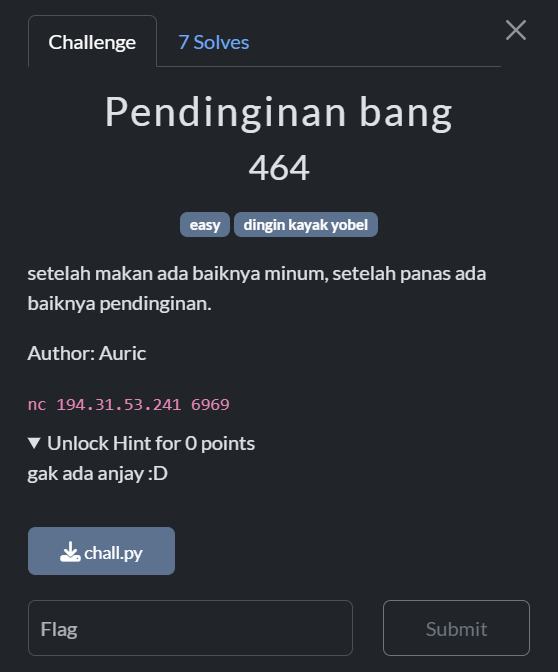
The challenge server on nc 194.31.53.241 6969 asks for a name; supplying one that satisfies bytes_to_long(name) % 2 == 1 (like yobe) produces the ciphertext and modulus (c, N, e)
$ nc 194.31.53.241 6969
HALO :D
sebut nama temen lu: yobel
temen lu gay

$ nc 194.31.53.241 6969
HALO :D
sebut nama temen lu: yobe
temen lu gak gay
Gua mau jujur sebenarnya gua suka sama lu gua sebenarnya cinta sama lu tapi lu...
sebut nama temen lu: yobe
temen lu gak gay
tralalelo tralala bombardino crocodilo tung tung tung sahur bim bim patapim erm what the sigma
sebut nama temen lu: yobe
temen lu gak gay
by the way I ada flag buat YOU ini I kasi YOU BEBAS{???????????????????????????????????????????????????}
cihui
c = 53383575738632890933919007201809515180274215349967266769889346629288828606636280594935266498988518105134443570782656716318431642134748216784338585137450013869091035475543793908039276816589371877327361693936678758220515992376801486355511001867944232932874692011207736022834689145768089912695423239991172823356
N = 137630826828095268667301967189197147546000582449312076424194666821022957118659825525612123826685031009515811709921676183585660168949575302621091936248580138706589746240730688590134879857054347019303644562633774379526910849164686617243019080891023555334899860670032867666500654840603944279608032649266049884807
e = 3
e = 3
c = pow(bytes_to_long(m.encode()), e, N)  # no padding
The plaintext m is the same every run (the three fixed lines + the flag), while (p,q,N) change each time. With small exponent e=3 and no padding, this is a textbook Håstad’s Broadcast Attack:
- For runs i=1..k we get:
c_i ≡ m^3 (mod N_i). - Use CRT to combine them into a single congruence:
C ≡ m^3 (mod ∏N_i). - If
m^3 < ∏N_i(i.e., enough runs), thenC = m^3over the integers, som = ⌊C^(1/3)⌋. - Decode
mto bytes → read the flag.
In my run I needed 7 ciphertexts.
Roughly: collect k ciphertexts until sum_i bitlen(N_i) > 3 * bitlen(m)
from Crypto.Util.number import long_to_bytes
import gmpy2

Cs = [
      17762034227646114423722383464223977930161505467197163778429691334444158645887003040134193232543567544113202283077652195961696058737108990628635736659647572176527199467121854224764909196901492924493130974475333225993776769202337536301016152581241273720852464761523020400321211662070555811245396325543559932122,
      97086199776969105210712394018725563621621383118442072607811816974732434928874839714493544241271366393561256659122385436275446954904679632937607457801734762735240834103192719661322419569951531803858728127001104881454834745985337558710873061191607219065968539245737476472283038383743851599178971115495757930594,
      67867010155040879595466856292677168671335145468474938820370611978620648252904161712173870204462435947265729112069778276590478536205993856831925452488279575098818442355150217117785531912247698585050297019453629325788357912716710158629413299355581758514800497796845633216967084887229415990406347852166716967666,
      39239660838242740727233042406784965567674849315300260573484144494469974974958381302660413887200665810473411189370148626778948496803414890996657172669887664933370884976564652891121744640957323563379403265060270166524875879540722692358521216901944104711253451757777736086111632678706109190619207579942659523414,
      26261772268028416312754645502891326099960649549615093741712774802102588574127452586504686301214158024240586053388182666043260028501671024698475971821808703447868307478874184968238934482429354260235390525908768437610556969022380954308672155099209592891257608739320074148006017334863080580123169802086192568870,
      76238283754784678919911823027423661446248699680018409360465717665753183584458697577277997321277792168403920943238390865367731110972903153442537309425593946243250295891171707522291365710345658814342517706958350198415592500144074435821558107231342150912606603002485414705303403746705303592229781864846323438495,
      26729930027253708636088366660234557365789371014972344030810629481224664415505893709886332884040928456342507782810254571711161672896448055938270745450763688996719689228816487700769039888563843080271842056309884853364789694509098291472258100158329295414212669011199269073486099527799827942712697201423278046208
     ]

Ns = [
    88986679396320364190738216504591833400206863398321375429005845612165612506514203785094904906943582199264059915545194805722532202564547912764604564320238543773675271433093073059674411745342458015234193301428308812249019782294062588453449696522939178041396345998957336298995637870182510172480794685510315758673,
    108259722871411839356963871565011809308551116072739208323572671772521053875850700252520918452077630297056327644375162905941464902453074922962443250654382131858799258087626161630254031223820529243739680809599823178203088342919569947754389752596779224284735734064275029458118765186143483438296048561090039809981,
    98264743073427768224870884780474300094091781953524501733700314925370105734175057670495165341107418298179150863601356582051761237635929643188898380246568077728068770036845838845681560660479588510780337765837412979572098995356286157271225225898857580471172491465325731297010275897825882298169531031809596842771,
    57002876428739962168707669755412341581139186624246506981914608829183387828094121207836232129083171742210886161633358380535494602372824503178080759902889975464534491699056912196022668867459177663286750666287230748159168896958449883179406814582712743178289433423563478033922773302577502299369542779384868823807,
    135131841070793955365611589818203400996581097263590374315494635068687678112506178294383067936133834382663173274319776998456270164166351359591686210856274756609725639794821021590762412431853945053858305933839007415480891802594561452724559241213711459939382637946183977335319193781429018109741569094743242666647,
    142405448620522655426358018392800743155011902282547467262124707595809514655582290634358859295895513163932623619105193601456107113643239331213535118795059462520756759746881997244851305050088030633293476639047870537761999898599135884607814100623127308215911039670563910779309382024369189627671126593604660977797,
    92587547654786177785261381314288447806302589079017653556641483964560145209158074079082705690287644016579239344084379191940196850986731669421099440491337460763340036258521835627972522658649816286441681828682823878223372857073878182316775706123526032548374406824823949996844711646847893558300917022820220322729
]
e = 3

def crt(res, mods):
    M = 1
    for m in mods: M *= m
    x = 0
    for r, m in zip(res, mods):
        Mi = M // m
        inv = int(gmpy2.invert(Mi, m))
        x = (x + r * Mi * inv) % M
    return x, M

C, _ = crt(Cs, Ns)
root, exact = gmpy2.iroot(C, e)
if not exact:
    raise SystemExit("Need more ciphertexts so that m^3 < ∏N")

pt = long_to_bytes(int(root))
print(pt.decode(errors="ignore"))
crtmerges all congruencesm^3 ≡ c_i (mod N_i)into one integerC.iroot(C, 3)returns the exact integer cube root ifCis a perfect cube (i.e., enough runs).- Convert to bytes and print → the full conversation text with the flag.
a
Gua mau jujur sebenarnya gua suka sama lu gua sebenarnya cinta sama lu tapi lu...
a
tralalelo tralala bombardino crocodilo tung tung tung sahur bim bim patapim erm what the sigma
a
by the way I ada flag buat YOU ini I kasi YOU BEBAS{kata_y0bel_f0rm4t_fl4gny4_b3b4zzz_tungtungtungsahur}
Flag: BEBAS{kata_y0bel_f0rm4t_fl4gny4_b3b4zzz_tungtungtungsahur}
Additive Transformation
The provided chall.py implements the Paillier cryptosystem.
It generates (n, g) as the public key and (λ, μ) as the secret key. Then it encrypts the flag:
c = encrypt(pk, r, bytes_to_long(flag.encode()))
print(c, sk[0], sk[1])  # it even leaks λ and μ
It also prints encryptions of small integers (3–12) using the same r value. Because Paillier is additively homomorphic:
$$ c_m = g^m \cdot r^n \pmod{n^2} $$
so consecutive ciphertexts satisfy:
$$ c_i^2 \equiv c_{i-1} \cdot c_{i+1} \pmod{n^2}. $$
From that, we can extract multiples of $n^2$ and compute gcd to recover $n^2$. Once we know $n$, the leaked (λ, μ) let us run the official decryption formula:
$$ m = L(c^\lambda \bmod n^2) \cdot μ \bmod n. $$
import gmpy2
from Crypto.Util.number import long_to_bytes

def L_function(x, n_val):
    return (x - 1) // n_val

def solve(filename="output.txt"):
    with open(filename, 'r') as f:
        lines = [line.strip() for line in f.readlines()]

    c_flag, lambda_val, mu = map(gmpy2.mpz, lines[0].split())
    known = {int(line.split()[1]): gmpy2.mpz(line.split()[0]) for line in lines[1:11]}

    ks = []
    for i in range(4, 12):
        ks.append(known[i]**2 - known[i-1]*known[i+1])
    n_sq = ks[0]
    for k in ks[1:]:
        n_sq = gmpy2.gcd(n_sq, k)
    n = gmpy2.isqrt(n_sq)

    c_pow_lambda = gmpy2.powmod(c_flag, lambda_val, n_sq)
    Lc = L_function(c_pow_lambda, n)
    m_int = gmpy2.f_mod(Lc * mu, n)

    flag = long_to_bytes(int(m_int)).decode()
    print("FLAG:", flag)

solve()
FLAG: PETIR{4dd1t1v3_3ncrYpti0n_crYpt0sYst3Ms_ar3_1nt3rest1ng_paillier1999}
Flag: PETIR{4dd1t1v3_3ncrYpti0n_crYpt0sYst3Ms_ar3_1nt3rest1ng_paillier1999}
Crocodilo Encryptilo
Upon accessing nc 194.31.53.241 33333, inspection of chall.py makes it clear that:
KEY = os.urandom(32)

adminPass = ''.join([random.choice(string.ascii_letters+string.digits) for _ in range(5)])

def encrypt(pt):
    IV = os.urandom(16)
    cipher = AES.new(KEY, AES.MODE_CBC, iv=IV)
    temp = pt+adminPass
    padding = pad(temp.encode(), 16)
    ct = cipher.decrypt(padding)
    return ct
- A random 5-byte
adminPassis appended to any plaintext. - The string is padded and then encrypted with AES-CBC.
- Note: it actually calls
cipher.decrypt()instead ofencrypt(), but since CBC decryption = blockwise AES + XOR, this leaks a predictable structure. - We can send chosen plaintexts and get ciphertexts back — a classic CBC byte-by-byte oracle.
- Option 2 (
brr brr patabim) asks for the admin password: if guessed correctly, it prints the flag.
So the idea is:
Use the oracle to leak adminPass one character at a time. We craft inputs that align the unknown byte at the end of a block, then compare CBC output differences to brute force candidates.
import pwn
import string

p = pwn.remote('194.31.53.241', 33333)

def get_hex_ct(payload):
    p.recvuntil(b'> ')
    p.sendline(b'1')
    p.recvuntil(b'text to translate > ')
    p.sendline(payload.encode())
    p.recvuntil(b'tralalelo tralala : ')
    return p.recvline().strip().decode()

charset = string.ascii_letters + string.digits
known_password = ""

print("🚀 Starting the attack...")

for i in range(5):
    padlen = 15 - len(known_password)
    target_payload = "A" * (16 + padlen)
    block1 = b"A" * 16
    target_ct = bytes.fromhex(get_hex_ct(target_payload))
    target_block2 = target_ct[16:32]
    target_hash = pwn.xor(target_block2, block1)

    print(f"[-] Searching for byte {i+1}...")
    for ch in charset:
        guess = known_password + ch
        block1_guess = b"B" * 16
        p2_guess = ("A" * padlen) + guess
        guess_payload = block1_guess.decode() + p2_guess
        guess_ct = bytes.fromhex(get_hex_ct(guess_payload))
        guess_block2 = guess_ct[16:32]
        guess_hash = pwn.xor(guess_block2, block1_guess)

        if guess_hash == target_hash:
            known_password += ch
            print(f"[+] Found byte {i+1}: '{ch}'")
            print(f"[+] Password so far: {known_password}")
            break

print(f"\n✅ Success! Full password found: {known_password}")

p.recvuntil(b'> ')
p.sendline(b'2')
p.recvuntil(b'what the sigma? : ')
p.sendline(known_password.encode())

print("\n--- Flag ---")
p.interactive()
[+] Opening connection to 194.31.53.241 on port 33333: Done
🚀 Starting the attack...
[-] Searching for byte 1...
[+] Found byte 1: 'g'
[+] Password so far: g
[-] Searching for byte 2...
[+] Found byte 2: 'S'
[+] Password so far: gS
[-] Searching for byte 3...
[+] Found byte 3: 'L'
[+] Password so far: gSL
[-] Searching for byte 4...
[+] Found byte 4: 'a'
[+] Password so far: gSLa
[-] Searching for byte 5...
[+] Found byte 5: 'u'
[+] Password so far: gSLau

✅ Success! Full password found: gSLau

--- Flag ---
[*] Switching to interactive mode
⠀⠀⠀⠀⠀⠀⠀⠀⠀⠀⠀⠀⠀⠀⠀⠀⠀⠀⠀⣀⣀⣀⣀⡀⠀⠀⠀⠀⠀⠀⠀⠀⠀⠀⠀⠀⠀⠀⠀⠀⠀⠀⠀⠀⠀⠀
⠀⠀⠀⠀⠀⠀⠀⠀⠀⠀⠀⠀⠀⣀⣤⣶⠞⢛⣿⠛⠻⢦⣎⠉⠙⠲⢦⣄⠀⠀⠀⠀⠀⠀⠀⠀⠀⠀⠀⠀⠀⠀⠀⠀⠀⠀
⠀⠀⠀⠀⠀⠀⠀⠀⠀⠀⣀⣴⠾⠿⠿⠶⢤⣄⡙⠻⠶⠟⠋⠀⠀⠀⢀⣈⡙⢶⣄⠀⠀⠀⠀⠀⠀⠀⠀⠀⠀⠀⠀⠀⠀⠀
⠀⠀⠀⠀⠀⠀⠀⢀⠴⠊⠁⠀⠀⠀⠀⠀⠀⠀⠉⠳⢤⡀⠀⠀⠀⠀⠘⠻⣿⣶⣈⡙⢦⣀⠀⠀⠀⠀⠀⠀⠀⠀⠀⠀⠀⠀
⠀⠀⠀⠀⠀⠀⡰⠃⠀⣠⠴⠒⠚⠉⠐⢒⡤⣀⠀⠀⠀⠙⢦⡀⠀⠀⠀⠀⠀⣽⣯⣤⣀⡙⢷⡀⠀⠀⠀⠀⠀⠀⠀⠀⠀⠀
⠀⠀⠀⠀⠀⡰⠁⣠⡞⢀⡴⠛⢄⢀⡔⠋⠳⡀⠑⢄⠀⠀⠀⠙⢦⡀⠀⠀⠀⠈⠉⠉⠉⠙⠛⠿⣄⡀⠀⠀⠀⠀⠀⠀⠀⠀
⠀⠀⠀⠀⢰⠃⢰⡿⠣⠋⠀⠀⠀⡅⠀⠀⠀⠙⣄⡤⢷⢄⠀⠀⠀⠙⢦⡀⠀⠀⠀⠀⠀⠀⠀⠀⠀⠛⠓⢦⣄⠀⠀⠀⠀⠀
⠀⠀⠀⠀⡎⢠⣿⠁⠀⠀⠀⠀⠀⣷⣀⠀⠀⠀⠀⢄⠈⣇⢑⣄⠀⠀⠀⠙⢦⡀⠀⠀⠀⠀⠀⠀⠀⠀⠀⠀⠈⠙⢦⡀⠀⠀
⠀⠀⠀⠸⡇⣞⠟⣄⠀⠀⡄⠀⠀⢻⡎⢆⠀⠀⢀⡈⣦⣸⡛⡇⠳⣄⠀⠀⠀⠻⣦⡀⠀⠀⠀⠀⠀⠀⠀⠀⠀⠀⠀⢻⣦⠀
⠀⠀⠀⠀⣧⡟⠀⢻⣦⡄⠸⡄⠀⠘⡟⣼⡷⣞⠉⣀⡸⠈⠛⢷⠀⡈⠢⡀⠀⠀⠈⠳⣦⡀⠀⠀⠀⠀⠀⢀⣠⡤⠖⠋⠁⠀
⠀⠀⠀⢸⢹⠁⢸⡀⢻⣿⣄⠹⡄⠀⢣⠙⠇⠈⣉⣠⣴⣶⣶⣾⣧⡇⠀⠹⣷⡄⠀⠀⠈⠻⣄⠤⠶⠶⠾⣿⡄⠀⠀⠀⠀⠀
⠀⠀⢠⣿⠘⠀⢺⣷⠈⡟⢟⣳⡼⠒⠊⠀⠀⢠⡿⣿⠋⠉⢹⠉⡇⡇⠀⠀⠘⣿⡄⠀⠀⠀⠙⣆⠀⠀⠀⠈⢿⡀⠀⠀⠀⠀
⠀⢠⣿⣿⠠⡀⠀⣿⣷⣧⣤⣭⣆⠀⠀⠀⠀⠀⠀⠹⣄⣠⠎⠀⡼⢠⠀⠀⠀⢹⣷⠀⠀⠀⠀⢸⡄⠀⠀⠀⠀⣷⠀⠀⠀⠀
⢀⡿⠁⣿⢀⠇⠀⢸⣿⡿⢻⡁⢸⠇⠀⠀⠀⠀⠀⠀⠀⠀⢀⣞⣴⠃⠀⠀⠰⣸⡏⡇⠀⠀⠀⢸⡇⠀⠀⠀⠀⢿⡆⠀⠀⠀
⢸⣷⣴⣿⠎⠀⠀⠀⢷⢳⡀⠛⠫⠀⠀⠀⢀⣀⡀⠴⠒⠊⠉⠁⡟⠀⠀⠀⠀⣿⣿⡇⠀⠀⠀⢸⡇⠀⠀⣠⣴⣾⡇⠀⠀⠀
⠀⠀⣠⣋⡼⡄⠀⠐⢌⣿⣇⠀⠀⠀⣠⣾⠟⠛⠛⡄⠀⠀⠀⠀⡇⠀⡀⠀⡄⢹⡿⠀⠀⠀⢀⡿⣀⣶⣿⣿⣿⣿⡇⠀⠀⠀
⠀⠈⠉⢹⣧⡯⡀⠀⠀⠙⢿⠒⠂⠀⠙⠧⢤⣤⠾⠃⠀⠀⠀⢠⠃⢠⡃⠀⢸⣌⡆⠀⠀⢀⣾⣿⣿⣿⣿⣿⣿⠿⠁⠀⡆⠀
⠀⠀⠀⠀⣿⣿⡁⠀⢀⡇⢸⣷⣤⣀⠀⠀⠀⠀⠀⠀⠀⣀⡴⡿⠀⣾⡇⠀⣸⠛⢿⣖⣺⣿⣿⣿⣿⣿⣿⠛⠁⠀⠀⡜⠀⠀
⠀⠀⠀⠀⣿⣿⡇⢀⢸⣿⣌⡟⢜⢮⣹⢶⡦⠤⣤⠾⣿⠟⣡⢃⣾⡿⢃⢀⡟⠒⠚⠛⠛⠿⢿⡿⢻⡧⣀⠑⢄⡀⣼⠀⠀⠀
⠀⠀⠀⠀⠘⠿⡇⢸⡄⣿⣿⠷⡀⠙⠣⠄⢙⠞⠥⢒⣨⣭⡿⠋⡿⠁⡆⣼⠁⠀⠀⢀⡠⠔⠛⣳⣄⢣⠈⠉⠒⠛⡇⠀⡀⠁
⠀⠀⠀⠀⠀⠀⣇⠈⣧⣿⠻⠷⢮⣄⣀⣀⡠⠤⣶⠞⠋⣁⣠⣴⠇⢀⣼⣿⣿⠿⠛⠛⠒⠲⣶⣻⠉⠻⣧⠀⠀⠀⣧⡜⠀⠀
⠀⠀⠀⠀⠀⠀⣿⡄⢏⡇⠀⠀⢀⠜⠋⠁⣀⣶⣿⡾⣿⠿⠿⣿⣴⠿⢿⣿⠀⠀⠀⠀⠀⠀⠸⣯⠀⠀⠈⠃⠀⠀⠘⣧⠀⠀
⠀⠀⠀⠀⠀⢠⡏⢃⡘⡇⠀⠀⢸⣠⣾⠟⠛⠋⢸⠃⣿⠀⢠⡿⠃⠀⢸⣿⠀⠀⠀⠀⠀⠀⠀⢹⡄⠀⠀⠀⠀⠀⠀⠈⢣⡀
⠀⠀⠀⠀⢀⡜⠀⠈⠧⣥⣀⣤⣾⠟⠉⠀⠀⢀⣾⢀⣿⠀⡿⠁⠀⠀⢸⣿⡇⠀⠀⠀⠀⠀⠀⠀⢷⠀⠀⣀⡤⠖⠚⠋⠉⠉
⠀⠀⠀⠀⠉⠀⠀⢀⣠⡞⣫⣿⠁⠀⠀⠀⠀⢠⡇⢸⣿⠀⠀⠀⠀⠀⢸⣿⡇⠀⠀⠀⠀⠀⠀⠀⢸⡶⠞⠁⠀⠀⠀⠀⠀⠀

KonekoCTF{0r4cl3_0r4cl3_0r4cl3_0r4cl3_0r4cl3_oracle+p4d_p4d_p4d_p4d_p4d_p4d_p4d_p4d_p4d_p4d-simple_1snt_1t?}1. translate to tralalelo tralala
2. brr brr patabim
3. Exit
> $
Flag: KonekoCTF{0r4cl3_0r4cl3_0r4cl3_0r4cl3_0r4cl3_oracle+p4d_p4d_p4d_p4d_p4d_p4d_p4d_p4d_p4d_p4d-simple_1snt_1t?}
Shadow Blueprint
I was given three files:
drive-guard.pyencryption-params.txtvault_blueprint.enc
The challenge description hinted about Coppersmith’s attack and specifically said: “7z instead of unzip”. That told me the .enc file was just a ZIP archive with 7z AES encryption.
First thing I did was check the archive with 7z:
7z l vault_blueprint.enc
Scanning the drive for archives:
1 file, 4073918 bytes (3979 KiB)

Listing archive: vault_blueprint.enc

--
Path = vault_blueprint.enc
Type = zip
Physical Size = 4073918

   Date      Time    Attr         Size   Compressed  Name
------------------- ----- ------------ ------------  ------------------------
2025-03-21 16:01:44 .....      2609024      2072776  main.dat
2025-03-21 16:01:44 .....      2609024      2000888  backup.dat
------------------- ----- ------------ ------------  ------------------------
2025-03-21 16:01:44            5218048      4073664  2 files
There were 2 files inside: main.dat and backup.dat, but the archive was password-protected. The challenge hinted that the password might be weak. So, I used John the Ripper with rockyou.txt:
john-the-ripper.zip2john vault_blueprint.enc > enc.hash
john-the-ripper --wordlist=rockyou.txt enc.hash
Warning: detected hash type "ZIP", but the string is also recognized as "ZIP-opencl"
Use the "--format=ZIP-opencl" option to force loading these as that type instead
Using default input encoding: UTF-8
Loaded 2 password hashes with 2 different salts (ZIP, WinZip [PBKDF2-SHA1 256/256 AVX2 8x])
Loaded hashes with cost 1 (HMAC size) varying from 2000860 to 2072748
Will run 8 OpenMP threads
Press 'q' or Ctrl-C to abort, 'h' for help, almost any other key for status
0g 0:00:00:35 5.50% (ETA: 17:47:03) 0g/s 25013p/s 50027c/s 50027C/s lennylove..kaooat
0g 0:00:01:48 16.63% (ETA: 17:47:16) 0g/s 23904p/s 47961c/s 47961C/s yockstar..yesterday6933

ujjain5rpst      (vault_blueprint.enc/backup.dat)
ujjain5rpst      (vault_blueprint.enc/main.dat)
2g 0:00:02:04 DONE (2025-08-18 17:38) 0.01608g/s 24111p/s 48223c/s 48223C/s unicorniosrosados..ufc82
Use the "--show" option to display all of the cracked passwords reliably
Session completed.
ujjain5rpst was the key. With the password I unpacked it:
7z x -p"ujjain5rpst" -oextracted vault_blueprint.enc
7-Zip 23.01 (x64) : Copyright (c) 1999-2023 Igor Pavlov : 2023-06-20
 64-bit locale=C.UTF-8 Threads:8 OPEN_MAX:1024

Scanning the drive for archives:
1 file, 4073918 bytes (3979 KiB)

Extracting archive: vault_blueprint.enc
--
Path = vault_blueprint.enc
Type = zip
Physical Size = 4073918

Everything is Ok

Files: 2
Size:       5218048
Compressed: 4073918
Reading drive-guard.py, I saw how these .dat files were created:
- Each original block of the file was padded with either
-MAINor-BAK. - Then it was encrypted with RSA, using
e = 5and a 1024-bit modulusn.
So every ciphertext block was basically: c = m^5 mod n, where m was a short padded message.
Since the message is only about 20 bytes long, m^5 is still way smaller than n (which is 1024 bits). That means no modular wraparound happened, the ciphertext was literally just m^5.
To decrypt, I didn’t need the private key. I just had to take the 5th root of each ciphertext block. I wrote a short Python script that:
- Split
main.datandbackup.datinto 128-byte chunks. - For each block, try taking the exact 5th root.
- Strip the
-MAINor-BAKtag. - Recombine everything back into the original file.
import re

t = open("encryption-params.txt").read()
n = int(re.search(r"n\s*=\s*(\d+)", t).group(1))
e = int(re.search(r"e\s*=\s*(\d+)", t).group(1))

main = open("extracted/main.dat","rb").read()
bak  = open("extracted/backup.dat","rb").read()

def chunks(b, k): return [b[i:i+k] for i in range(0, len(b), k)]
C1 = [int.from_bytes(ch, "big") for ch in chunks(main, 128)]
C2 = [int.from_bytes(ch, "big") for ch in chunks(bak,  128)]

A = int.from_bytes(b"-MAIN", "big")
B = int.from_bytes(b"-BAK",  "big")
a = 256

def iroot_k(n, k):
    lo, hi = 0, 1 << ((n.bit_length() + k - 1)//k)
    while lo <= hi:
        mid = (lo+hi)//2
        p = mid**k
        if p == n: return mid, True
        if p < n: lo = mid+1
        else: hi = mid-1
    return hi, False

out = bytearray()
for i, (c1, c2) in enumerate(zip(C1, C2)):
    r, ok = iroot_k(c1, e)
    if ok:
        m_main = r
        X = (m_main - A) // (a**5)
    else:
        r2, ok2 = iroot_k(c2, e)
        if not ok2:
            raise SystemExit(f"Block {i}: 5th-root not exact, needs Sage fallback")
        m_bak = r2
        X = (m_bak - B) // (a**4)
    blk = X.to_bytes(16, "big")
    out += blk

out = bytes(out).rstrip(b"\x00")

open("blueprint.bin","wb").write(out)
try:
    print(out.decode())
except:
    print(f"Recovered {len(out)} bytes -> saved to blueprint.bin")
Recovered 326126 bytes -> saved to blueprint.bin
After running the script, I got a file called blueprint.bin.
Checking the file:
file blueprint.bin
blueprint.bin: PNG image data, 940 x 639, 8-bit/color RGBA, non-interlaced
It turned out to be a PNG image. I renamed it:
mv blueprint.bin blueprint.png
Opening the image showed a glowing vault blueprint, and at the bottom, the flag: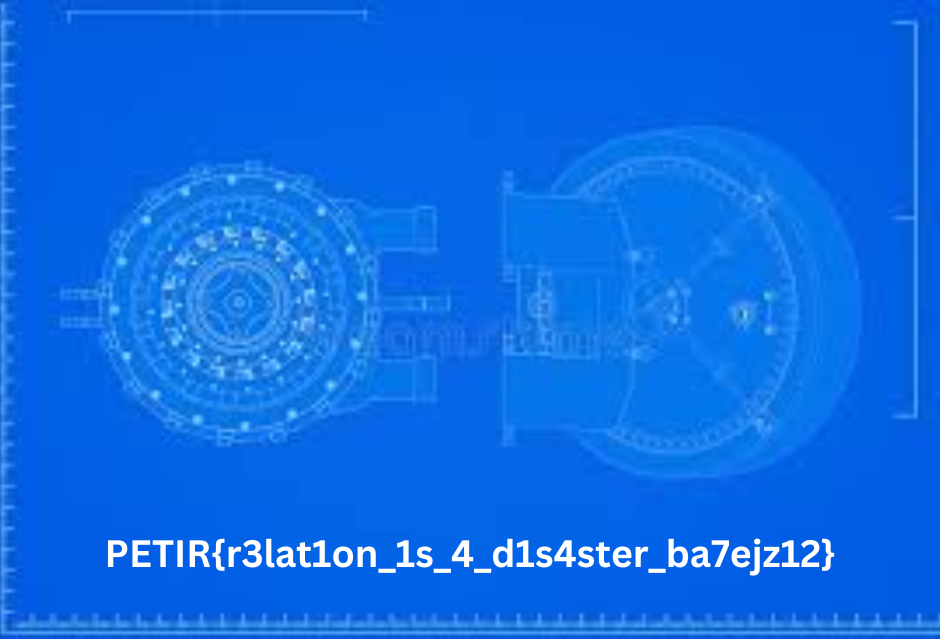
Flag: PETIR{r3lat1on_1s_4_d1s4ster_ba7ejz12}
Orthogonal Gridlock (soon)
masih sedang bertapa mencari pencerahan
Guess God (soon)
masih sedang bertapa mencari pencerahan
--python (soon)
masih sedang bertapa mencari pencerahan